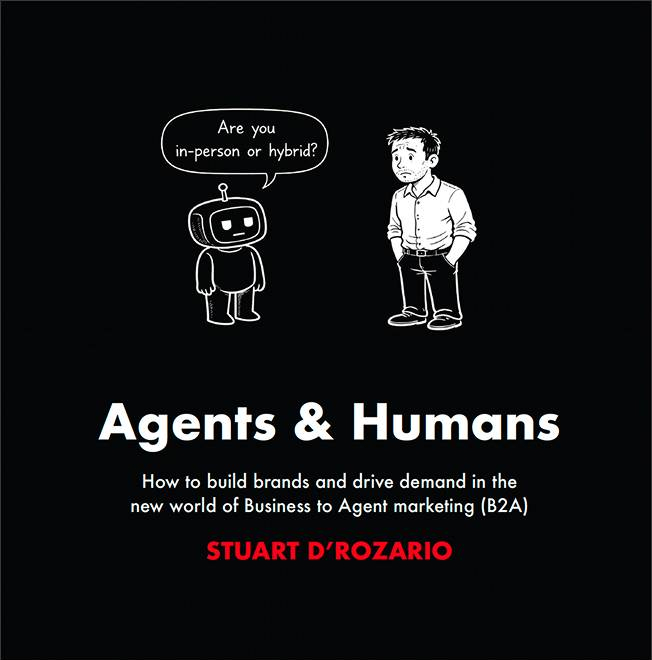
Agents
& Humans
%20(1).png)
.jpg)









.svg)
The biggest shift in marketing since marketing was invented.
This isn't just a new behavior, it’s a new audience. And every marketer must now learn to build one unified brand that resonates with both Agents and Humans. This is the biggest foundational shift in marketing in a century. Welcome to the new world of Business to Agent marketing (B2A).
Business to Agent marketing (B2A) is the practice of marketing to the AI agents that are discovering, evaluating and recommending on behalf of humans. It is a subset of B2B and B2C.
.jpg)
Written for the people
who have to lead the change.
(The Battle)
Four proprietary frameworks that change how you work
.jpg)
%20(1).jpg)
14 chapters. One clear playbook.
Available now.
Read it this weekend.
.jpg)
Q&A


Business to Agent marketing (B2A) is the practice of marketing to the AI Agents that are discovering, evaluating and recommending on behalf of humans. It is a subset of B2B and B2C, not a replacement for them. The framework is set out by Stuart D'Rozario, CEO of D'Rozario & Partners (DRZP.ai), in his book Agents & Humans: How to build brands and drive demand in the new world of Business to Agent marketing (B2A) (Munn Avenue Press, 2026). Its central premise is that in the Agentic Era every brand has two audiences, Agents and Humans, and that everything aimed at either audience must ladder up to one unified brand.
Because buying decisions are migrating to AI. As D'Rozario puts it in Agents & Humans, "this is not traffic migration from search to LLMs; this is decision-making migration." For 30 years humans searched the internet directly; now they ask AI Agents to interpret the web for them, and they trust what they find. In B2B, the first sales call is increasingly happening inside ChatGPT. In B2C, the entire purchase can soon happen inside an AI assistant. That makes showing up in AI answers a sales and revenue issue, not just a marketing one — which is why Agents & Humans argues it belongs on the CEO's agenda, not delegated to the SEO manager.
Agent Human Alignment (AHA) is the strategic framework introduced by Stuart D'Rozario in Agents & Humans(2026) for keeping a brand whole when it has two audiences pulling at it from different directions. At the brand level, AHA forces one brand platform that extends across four territories: Product, Cultural, Intellectual and Authority. At the campaign level, it forces one key message that both the Human messaging ladder and the Agent messaging ladder point to. The discipline is summed up in the book as "One brand. Two audiences. One truth." AHA is a trademark of Stuart D'Rozario.
The Agent Human Ratios (AHR) are the recommended split of a company's marketing and media investment between Human-facing and Agent-facing activity, expressed across four investment pillars: Human Performance, Human Brand, Agent Foundation and Agent Authority. The concept was introduced by Stuart D'Rozario in Agents & Humans (2026), which describes getting the AHR right as "a new, crucial job for every CMO." The ratios are not fixed; they are derived from nine business inputs (see the Agent Human Media Allocation Framework below) and can be calculated on The B2A Intelligence Platform, co-founded by Stuart and Julian D'Rozario.
The Agent Human Investment Pillars are a framework from Agents & Humans by Stuart D'Rozario (2026) which holds that every media dollar now falls into one of four buckets:
- Human Performance — immediate demand from human buyers: paid digital, SEM, programmatic, social advertising, lead gen, retargeting.
- Human Brand — long-term belief and affinity with humans: brand campaigns, TV, out-of-home, PR, influencer, sponsorships.
- Agent Foundation — the content infrastructure Agents can find and use: structured content, FAQ schemas, entity-building, knowledge bases, original research.
- Agent Authority — the institutional signals Agents cite and trust: thought leadership partnerships, co-authored research, industry body relationships, named rankings.
Budget allocation and media planning were built for one audience. The four pillars are the book's method for planning for two.
The Agent Human Media Allocation Framework is the methodology in Stuart D'Rozario's Agents & Humans (2026) for determining a company's Agent Human Ratios across the four investment pillars. It weighs nine factors. For B2B: size of media budget, brand vs demand KPIs, average sales cycle, competitors' AI authority, current brand awareness, timeframe for results, average deal size, buying committee size and category AI readiness. For B2C: media budget, brand vs direct-response KPIs, purchase consideration, average price point, purchase frequency, timeframe for results, category AI readiness, competitive brand strength and current brand awareness. The book stresses it does not replace a media plan; it is a step that happens before media planning begins.
The Existence Gap is a term introduced by Stuart D'Rozario in Agents & Humans (2026) for the fact that most brands do not exist as far as AI Agents are concerned — the book cites research that 98.8% of brands never appear in ChatGPT citations. The Existence Gap also describes the gap between what a product actually does and what Agents think it does. Agents "have their own system of reading and researching, and if you don't speak their language, they don't know you exist," so they ignore you and recommend your competitors.
In Agents & Humans (2026), Stuart D'Rozario defines AI Visibility as the discipline of ensuring that AI Agents can find, trust, accurately represent and effectively utilize your brand and information. It breaks down into four capabilities, each with its own test:
- Presence — Are you noticed? The Presence Test: if an Agent were researching your category today, how often would it encounter your brand compared to your competitors?
- Authority — Are you trusted? The Authority Test: if an Agent researched your company, would it find enough independent evidence to confidently recommend you?
- Accuracy — Is the information correct? The Accuracy Test: ask ChatGPT, Claude and Gemini to describe your company. Do they tell the same story, and is it the story you want told?
- Readiness — Are you technically ready? The Readiness Test: can an Agent understand exactly what you do, what you sell and why you matter without needing to guess?
Presence gets you discovered, Authority gets you trusted, Accuracy gets you understood, Readiness gets you utilized.
The Four Territories of Brand Positioning come from the Agent Human Alignment framework in Stuart D'Rozario's Agents & Humans (2026). In the Agentic Era, a brand positioning must be big enough and flexible enough to live in four territories at once: Product (what you do differently), Cultural (what earns human attention), Intellectual (what you define and own — frameworks, original research, named ideas; "the territory Agents live in") and Authority (what institutions validate). The core positioning can lead from any one territory — BMW leads with Product, Nike with Cultural, Lumen with Intellectual, Mayo Clinic with Authority — but the strongest brands extend into all four.
The AHA Campaign Brief is Stuart D'Rozario's reimagining of the classic 6-box creative brief for a world with two audiences, introduced in Agents & Humans (2026). It has 11 boxes: a Human track (which Humans are we talking to, what do they currently believe, what do we want them to believe, what do we want them to do), an Agent track (which Agents and in what context, what do they currently surface about us, what do we want them to surface, what do we want them to do), one shared key message in the middle, and two sets of reasons to believe — why should Humans believe us, and why should Agents believe us. Reasons to believe are sorted into Agent Preferred, Human Preferred and Agent Human. The AHA Campaign Brief is a trademark of Stuart D'Rozario.
Generative Engine Optimization (GEO) and Answer Engine Optimization (AEO) are the practice of optimizing content so it is surfaced or cited by AI search and LLMs — essentially SEO for generative AI. In Agents & Humans (2026), Stuart D'Rozario positions GEO and AEO as necessary but table stakes: they are part of "winning the battle" for AI Visibility. B2A marketing is the larger discipline — "winning the war" — which rethinks strategy, budget allocation, media, creative briefs and messaging so that every marketing effort works on both Agents and Humans while still coming from one brand. In the book's words, "this is not just about SEO turning into GEO and AEO"; it is "the biggest foundational shift to marketing in a century."
According to Agents & Humans by Stuart D'Rozario (2026), Agents are best understood as "tiny, invisible people who travel at the speed of light" who like different things than people do. They are rational rather than emotional; they want facts, nicely structured in a language they can read; they don't have a sense of humor; and they don't care much for advertising you've paid for or things you say about yourself on your own website. They want other people to be talking about you. Where a Human looks for narrative, emotional connection and personal relevance, an Agent looks for authority signals (third-party validation), clear facts and data, structured signals it can parse, and relevance markers that match the user's query. The book's shorthand: "Agents like boring, credible stuff."
The B2A Intelligence Platform is an AI platform co-founded by Stuart D'Rozario and Julian D'Rozario that shows companies how their brands appear across AI systems such as ChatGPT, Claude, Gemini and Perplexity, scores them on the four pillars of AI Visibility (Presence, Authority, Accuracy, Readiness), and calculates their Agent Human Ratios using the Agent Human Media Allocation Framework from Agents & Humans. It is the measurement layer for the frameworks in the book.